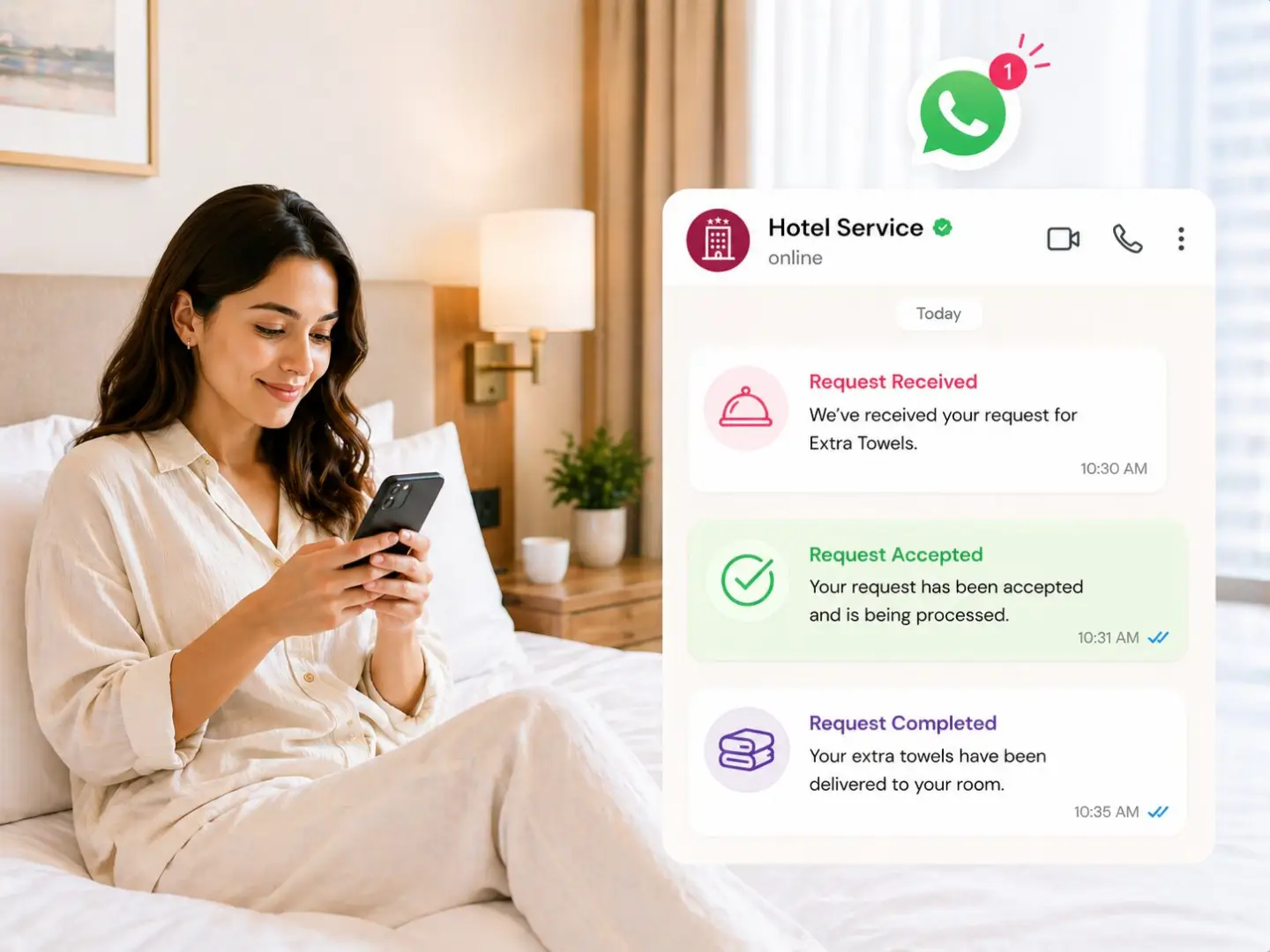
WhatsApp is not a channel, it is the channel in Portugal. Ninety-two percent of Portuguese travellers between 18 and 55 use it daily. On the Talk with Guest customer base — 214 European properties as of December 2026 — WhatsApp accounts for 71 percent of guest-initiated pre-arrival messages and 68 percent of in-stay requests. Every hotelier I speak to knows this and yet fewer than one in four independent Portuguese hotels runs a serious WhatsApp automation programme. This playbook is the shortest path from where most properties are today to a WhatsApp operation that pays for itself in the first month.
The playbook is six flows. Each flow has a purpose, a target metric, template copy in Portuguese and English you can adapt, and the traps we have watched properties fall into. It is written by me, André, and it draws on the boutique group we ran in Chiado before I co-founded Guest Talk. The templates are exactly the ones we ship in the Talkguest message library, so if you are on the platform you already have them; if you are not, you can copy them into whatever tool you are running.
Flow one: instant booking acknowledgement
Purpose: replace the transactional confirmation email with a WhatsApp message that lands within thirty seconds of the booking, in the guest's own language.
Target metric: 95 percent delivery rate, 78 percent read rate within the first hour.
Template copy (PT): "Olá {name}, obrigado pela sua reserva no {hotel} para {checkin_date}. Já tem tudo confirmado. Nos próximos dias vamos enviar-lhe a morada, a informação sobre estacionamento e uma sugestão de transfer do aeroporto. Se precisar de nós antes disso, basta responder a esta mensagem."
Template copy (EN): "Hello {name}, thank you for your reservation at {hotel} for {checkin_date}. Everything is confirmed. Over the next few days we will send you the address, the parking information and an airport-transfer suggestion. If you need anything sooner, just reply to this message."
Trap: sending this from a personal WhatsApp account. If your property is above ten keys and you are using a personal WhatsApp number, you are outside the WhatsApp Business Solution Provider terms of service and Meta can suspend the number without notice. Use a proper BSP — Talkguest partners with 360dialog for Portuguese properties and the connection is turnkey. See the WhatsApp Business API setup guide for the technical detail.
Flow two: T-7 airport-transfer offer
Purpose: attach ancillary revenue with a single-click accept, seven days before arrival when the guest is still finalising their travel.
Target metric: 22 to 28 percent attach rate on inbound-airport reservations at Lisbon and Porto, 14 to 18 percent at Faro.
Template copy (PT): "Olá {name}, vai chegar a {city} dia {checkin_date}? Podemos organizar-lhe um transfer directo do aeroporto por {price} EUR (carro privado, até 4 pessoas). Basta responder SIM e tratamos de tudo."
Trap: do not offer a transfer if you do not have a reliable partner. A cancelled transfer at midnight in a foreign city is worth more negative reviews than the entire year of successful transfers is worth positive ones. The Talkguest partner list for Lisbon transfers has been Yellow Transfers since 2024, and we recommend the same driver profile per repeat guest where possible.
Flow three: T-3 arrival information
Purpose: reduce the number of "how do I get to you" and "where is parking" questions that consume reception time in the first ninety minutes of every check-in.
Target metric: reduce inbound "how do I find you" messages by 70 percent between T-3 and T-0.
Template copy (EN): "Hello {name}, three days to go. The address is {address}. If you drive: the underground car park at {parking_partner} is 3 minutes away and costs {parking_price} per day; we can pre-book a spot if you like. Check-in from 15:00, but if you arrive earlier we can hold your luggage. Anything else you want to know?"
Trap: making this message too long. If your guest has to scroll they will stop reading. Keep it to five lines. Everything else lives in the neighbourhood guide behind a single link.
Flow four: check-in day arrival window
Purpose: capture an expected arrival time so reception can plan the front desk and pre-authorise the card without the guest queueing.
Target metric: 85 percent of guests reply with a time, average check-in duration reduced from six minutes to under two.
Template copy (PT): "Bom dia {name}, hoje vai receber-nos! Aproximadamente a que horas pensa chegar? Se puder responder com uma hora ou uma janela de 30 minutos, temos tudo preparado para si à sua chegada."
Trap: sending this at 6 in the morning. Send it at 9:30. Guests who set an alarm to check in at 3pm do not want a notification at dawn.
The best WhatsApp automations feel like a knowledgeable friend texting the right thing at the right time. The worst feel like an airline app. Aim for the first.
Flow five: in-stay support handoff
Purpose: give the guest a single reliable channel to reach reception during their stay, and route conversations to the right team internally.
Target metric: median first-response time under 4 minutes during opening hours, under 25 minutes overnight with the auto-reply layer.
The Talkguest messaging module routes conversations by keyword and by reservation state. If the guest writes "hairdryer", the message goes to housekeeping. If the guest writes "room too warm", it goes to maintenance with the room number attached. If the guest writes at 2 AM, the auto-reply layer sends a holding message and reception picks it up in the morning. All of this is configurable per property.
Trap: assuming the auto-reply layer replaces reception. It does not. It buys you time and it filters obvious cases. The best properties on our platform treat auto-reply as a triage layer, not a substitute for a human. The Faro aparthotel case study walks through how they set this up.
Flow six: T+2 post-stay review request
Purpose: turn positive in-stay sentiment into public reviews on the platforms that matter for future bookings.
Target metric: 4x increase in review submission rate versus email-only, with a review score 0.3 points higher on average because unhappy guests are triaged privately first.
Template copy (EN): "Hello {name}, thank you for staying with us. If your visit was as good as we hoped, would you leave us a review on Google? It takes one minute and it helps other travellers find us. And if anything at all was not perfect, just reply here — we would rather hear it from you first."
Trap: never trigger this on a guest who wrote a complaint during their stay. The Talkguest reputation module suppresses this flow automatically if the in-stay sentiment score is below a threshold.
The metric that ties them all together
Every one of these flows produces a message. The metric that matters over time is guests per conversation, which we define as the average number of two-way exchanges per reservation. A property that sends confirmation emails and nothing else runs at roughly 0.3 conversations per reservation. A property with all six flows running well sits at 4.1 to 4.8. That number tracks review score, direct-booking share, and pace uplift better than any other single metric we watch, which is why it lives at the top of the Talkguest revenue analytics dashboard.
If you want to get all six flows running by the end of the month, ask for access at /get-access. Onboarding takes two weeks and the messaging module is live on day three. If you are on Talkguest already, the template library is under Messaging → Templates → Portugal 2027; the copy in this article is the same as what you will find there.