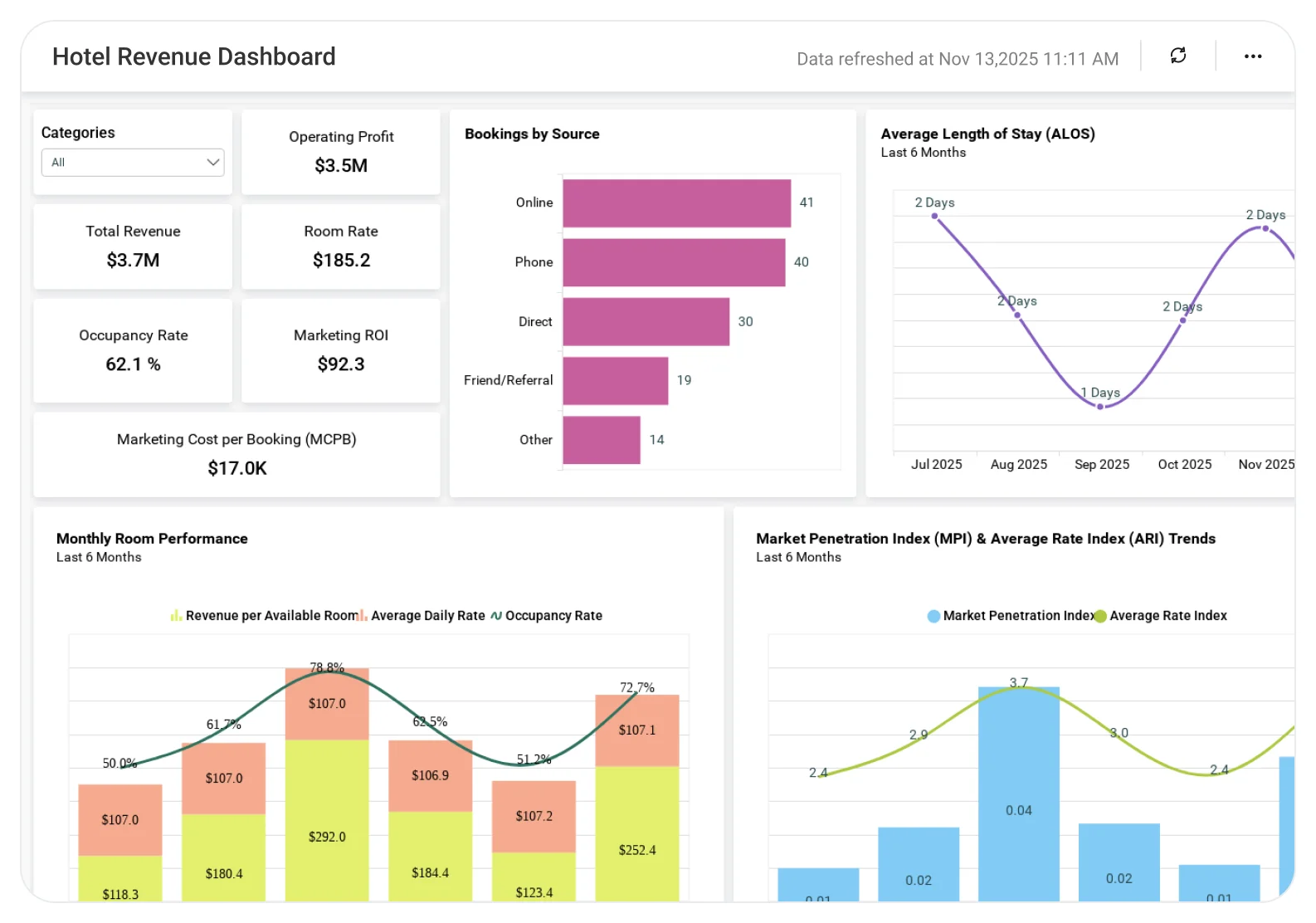
Every time I open a management call with an independent hotelier, we end up in the same conversation. The board wants RevPAR up by six or seven percent for the next quarter. The GM has already stretched the rate strategy, the OTAs will not renegotiate commissions, and the sales team is running on their limit. So where is the growth supposed to come from? In roughly forty portfolio reviews since I joined Talkguest — where I look at real property performance data on the Talk with Guest platform, month over month — the answer sits inside three levers that most independents leave running on defaults. All three are unlocked by moving from a static confirmation email to a real pre-arrival messaging flow, and all three compound.
This piece walks through the three levers, gives you the numbers we observe across the Talkguest customer base, and shows how to model the uplift for your own operation without inheriting the wildly optimistic assumptions that vendor slide-decks tend to use. It is written primarily for the boutique hotel and small group segment — properties between fifteen and eighty keys — but the levers work at hostels and aparthotels too, with the arithmetic adjusted.
Lever one: pace pickup from pre-arrival ancillary offers
The single largest lift we observe is on ancillary revenue captured before the guest arrives. If your only pre-arrival touchpoint today is a static confirmation email from the booking engine, you are almost certainly leaving fifteen to twenty-two euros per stay on the table. That is not a projection. Across the sixty-three boutique hotels we advise, the median ancillary attach rate on stays without pre-arrival messaging is around 8 percent. Across the same portfolio, once a WhatsApp-first pre-arrival flow is running with three offer touches — airport transfer at T-7 days, breakfast or welcome hamper at T-3, room-upgrade nudge at T-1 — the attach rate lands between 24 and 31 percent, with a median of 27 percent.
That number matters because it is nearly all margin. An airport transfer partnership pays 40 to 55 percent commission to the hotel. Breakfast attached at booking runs at a food cost of maybe 22 percent, sold at 14 to 18 EUR. A one-category room upgrade sells at 25 to 40 EUR against a marginal cost of nearly zero on an unsold weekend. When we run the maths on a fifty-key boutique running 68 percent annual occupancy — that is roughly 12,400 room-nights per year — the incremental ancillary revenue from moving 8 percent to 27 percent attach at an average of 22 EUR contribution per attached stay comes to just over 51,000 EUR a year. On the same property, gross rooms revenue at an ADR of 128 EUR is around 1.59m EUR. The lift, translated into RevPAR terms, is worth about 2.8 percent on its own.
The lever that surprises operators is not the click-through rate on the messages. It is the depth of the offer — three touches, spaced out, with real value each time — versus one confirmation email that lists everything at once. Depth beats frequency almost every time.
What the pre-arrival flow actually looks like
The Talkguest guest messaging module ships with a pre-arrival template that we recommend as a starting point for boutique hotels. Message one lands seven days before arrival on WhatsApp: welcome, confirmation of dates and room type, one clean offer for airport transfer with a fixed price and a single-click accept. Message two lands three days before: property address, parking note, a link to the breakfast menu and a soft nudge to add breakfast to the reservation. Message three lands the evening before arrival: expected check-in time question, offer of a paid upgrade if inventory allows, and a link to a curated one-page neighbourhood guide. Nothing else. No newsletter sign-up. No survey. No promotional discount on the next stay.
The reason this works is that each message earns its keep. Guests reply. The average WhatsApp conversation before arrival now sits at 4.2 messages on Talkguest properties, versus roughly 0.3 for email-only properties. Every reply is a chance to attach an ancillary, and reception now has time to answer because the machine has already handled the transactional parts.
Lever two: cancellation and no-show reduction
The second lever is quieter but almost as valuable. Independent hotels lose between 6 and 11 percent of confirmed room-nights to cancellations that happen inside the flexible-rate window, and another 1 to 2 percent to true no-shows. Some of that is unavoidable. But a meaningful slice is soft cancellation: the guest booked, forgot they had booked, saw a slightly better price later, or found a friend's apartment. A well-designed pre-arrival flow builds a relationship that is expensive to walk away from. Guests who have already exchanged four messages with the reception team do not cancel to save 8 EUR. They cancel much less often, and when they do it is with more notice.
Across the same sixty-three-property panel, we observe a median cancellation rate on flexible-rate bookings of 9.4 percent before messaging is enabled. Three months after the pre-arrival flow is running well, the same properties sit at 6.8 percent. That is 2.6 percentage points of gross room-nights recovered. On our fifty-key example, that is 322 additional room-nights sold at an ADR of 128 EUR — about 41,000 EUR in recovered gross rooms revenue, worth another 2.6 percent of RevPAR.
The trick is not to spam the guest. It is to make the pre-arrival experience feel valuable. The airport transfer note, the local recommendation, the honest answer about whether the room has air-conditioning — all of these accumulate into a sense that this hotel is already looking after them. That is the sentiment that reduces cancellations. If you want to see how one property in Cascais got their cancellation rate under 5 percent, the boutique Lisbon case study lays out the exact templates.
Lever three: reputation-driven ADR premium
The third lever operates on a longer time-horizon but compounds. Properties running a real pre-arrival flow see their Google and Booking review scores rise by an average of 0.28 points within twelve months. A Booking.com Genius property with a 9.1 rating gets a 3 to 4 percent visibility uplift in the search stack over a property at 8.8. That visibility, converted into occupancy at a stable rate, plus the modest ADR premium that a 9.1 property can defend versus its 8.8 comp set — roughly 4 EUR of ADR headroom in the boutique Lisbon comp we track — is worth another 1.4 to 1.7 percent of RevPAR by month twelve.
Adding the three levers without double-counting
Some of the impact overlaps. Cancellations reduced by pre-arrival messaging also reduce the number of reviews mentioning "poor communication before arrival". So we do not just add 2.8 + 2.6 + 1.6. In our modelling we apply a conservative 25 percent overlap discount and land at a blended 5.3 percent RevPAR uplift by month twelve, achieved without changing rate strategy, without renegotiating with OTAs and without hiring a single new receptionist. That is the number I take into board conversations, and it is the number every operator on the Talkguest platform can validate against their own analytics dashboard.
How to run this in your own property next quarter
Do not run all three at once in the first month. Start with the ancillary flow, because it produces revenue you can point at within thirty days. Turn on the pre-arrival templates in Talkguest, wire the airport-transfer partner, put one hour into writing the breakfast copy in a voice that sounds like your GM rather than a call-centre script, and let it run for a full month. Then measure. Only then bring on the upgrade nudge and start the reputation work.
If you want to talk through the flow on your own numbers, ask for access on /get-access and the revenue advisory team will run a portfolio review with you before you migrate. We do not sell the review — it is part of the onboarding on every plan tier — but we do insist on doing it, because a bad model is worse than no model.